


Divorce isn’t just an emotional storm – it’s a legal puzzle, and the wrong move can haunt you for years. If you’re searching for divorce lawyers in Chandigarh, you’re probably wrestling with questions about child custody, alimony, property division, or simply how to start the process without making costly mistakes. Chandigarh’s legal scene is crowded, but not all family law attorneys offer the same expertise or results. Here’s what you need to know to make a clear, informed choice, whether you’re facing an urgent separation or just weighing your options.
If you need fast, reliable help with divorce, Chandigarh offers a range of top-rated legal services. The best divorce lawyers in Chandigarh combine strong court representation, in-depth knowledge of family law, and practical guidance on issues like child custody, marital dispute resolution, and property division. Always verify their experience, client reviews, and specialization in family law before making your first appointment.
Understanding Divorce Law in Chandigarh
Divorce law in Chandigarh is shaped by India’s personal law system, which means the rules differ depending on your religion and marriage type. The main statutes are:

- Hindu Marriage Act, 1955 (for Hindus, Sikhs, Buddhists, Jains)
- Special Marriage Act, 1954 (for inter-faith or civil marriages)
- Indian Divorce Act, 1869 (for Christians)
- Muslim Personal Law (Shariat) Application Act, 1937 (for Muslims)
Each law outlines specific grounds for divorce, timelines, and procedures. For example, the Hindu Marriage Act allows divorce on grounds like cruelty, desertion, adultery, or mutual consent. The Special Marriage Act is often used by couples in inter-caste or inter-religious marriages and has its own process.
Why Local Expertise Matters
Not every lawyer understands the subtle differences between these laws, or the way Chandigarh’s courts handle family cases. An experienced local advocate knows the judges, the court staff, and even the practical quirks – like which days certain matters are listed or how mediation is managed in Sector 17’s family court.
Common Legal Challenges in Divorce Cases
- Proving grounds for divorce (adultery, cruelty, desertion, etc.)
- Deciding child custody and visitation rights
- Calculating maintenance or alimony
- Dividing property and assets
- Navigating mutual consent vs. contested divorce
- Handling false allegations or counter-cases
Choosing the Right Divorce Lawyer in Chandigarh
Hiring a divorce lawyer is not just picking a name from Google. The right advocate can make all the difference, especially when emotions run high and stakes are real.
What Makes a Lawyer Top-Rated?
- Specialization: Focus on family law, not just general practice
- Track record: Proven results in divorce, custody, and property cases
- Client feedback: Consistently positive reviews, testimonials, or peer recognition
- Courtroom experience: Regular appearances in Chandigarh’s District Courts and Punjab & Haryana High Court
- Transparent billing: Clear fee structure, no hidden charges
Interview Questions to Ask
Before hiring, ask:
- How many divorce cases have you handled in Chandigarh?
- What percentage of your work is family law?
- Have you dealt with cases similar to mine (e.g., NRI divorce, high-value property, complex custody)?
- What’s your approach to negotiation vs. litigation?
- What are the likely costs and timelines?
- Who will handle my case day-to-day?
Red Flags to Watch For
- Vague about experience or number of cases
- Over-promising outcomes
- Unclear or constantly shifting fees
- Poor communication or long response times
- Lack of written agreement or engagement letter
Types of Divorce Lawyers and Legal Services
Not every family law attorney offers the same services. Here’s how they differ:
1. Mutual Consent Divorce Lawyers
- Draft and file joint petitions
- Guide through mandatory cooling-off period (minimum 6 months, can sometimes be waived)
- Handle court appearances and mediation
- Ensure proper agreement on alimony, child custody, and property
2. Contested Divorce Lawyers
- Represent clients in cases with allegations (cruelty, adultery, desertion)
- Collect and present evidence
- Cross-examine witnesses
- Handle counter-cases (like 498A or domestic violence)
3. Child Custody Lawyers
- Advise on sole, joint, or shared custody
- Prepare visitation schedules
- Represent in interim and final custody hearings
- Handle modification or enforcement of custody orders
4. Property Division Specialists
- Assess marital and ancestral property
- Advise on division under Hindu Succession Act, Transfer of Property Act, etc.
- Draft settlement agreements
- Represent in property partition suits if needed
5. NRI Divorce and International Cases
- Handle cases with parties outside India
- Advise on international child abduction, Hague Convention issues
- Coordinate with foreign lawyers for recognition of Indian divorce decrees
The Divorce Process in Chandigarh: Step by Step
Divorce in Chandigarh usually follows a set pattern, but the details depend on whether it’s mutual consent or contested.
Mutual Consent Divorce Process
- Both spouses agree to separate and terms (alimony, custody, property).
- Joint petition filed in family court (usually Sector 17).
- First motion statement recorded; six-month waiting period starts.
- Second motion after waiting period; court verifies consent is genuine.
- Decree of divorce granted if all is in order.
Contested Divorce Process
- One spouse files a petition stating grounds (with evidence).
- Court issues notice to the other spouse.
- Response filed; court may order mediation.
- If not settled, evidence and witnesses presented.
- Court delivers judgment; may grant or deny divorce, decide on custody, alimony, property.
Key Documents Required
- Marriage certificate (original and copies)
- Address proof (Aadhar, passport, utility bills)
- Passport-size photographs
- Income and asset proofs
- Details of children (if any)
- Evidence supporting grounds for divorce (messages, photos, medical reports, etc.)
Common Mistakes and How to Avoid Them
People often make avoidable mistakes that delay or damage their case. Here are the most frequent ones:
- Hiding income or assets (leads to adverse inference by the court)
- Signing blank papers or vague agreements
- Ignoring mandatory mediation sessions
- Letting anger drive decisions instead of legal advice
- Relying on non-specialist lawyers or relatives
- Failing to document abuse, threats, or harassment
- Not keeping copies of all filings and orders
Costs and Timelines: What to Expect
Legal fees in Chandigarh range widely. There’s no fixed rate, but general patterns include:
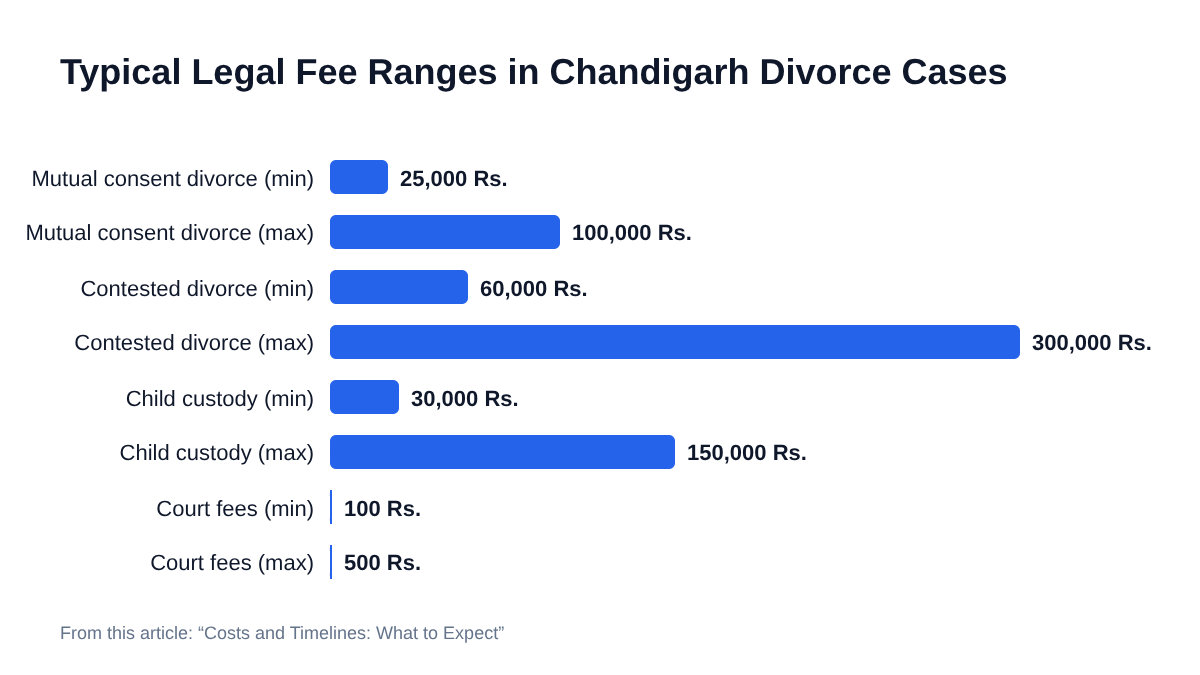
- Mutual consent divorce: Rs. 25,000 – 1,00,000 total (includes drafting, filing, two appearances)
- Contested divorce: Rs. 60,000 – 3,00,000 or more, depending on complexity and duration
- Child custody cases: Often billed separately; Rs. 30,000 – 1,50,000 typical
- Property disputes: Fees depend on asset value and number of hearings
Other costs:
- Court fees (usually Rs. 100 – 500 per petition)
- Documentation and notary charges
- Mediation or counseling fees if required
Timelines:
- Mutual consent: 6 – 18 months (can sometimes be faster if cooling-off period is waived)
- Contested: 2 – 5 years, sometimes longer if appeals or multiple cases
Marital Dispute Resolution Options in Chandigarh
Not every dispute needs to end in litigation. Chandigarh law firms offer:
- Mediation: Both spouses meet with a neutral third party to try resolving issues amicably. Family courts often refer cases to mediation cells in Sector 17.
- Conciliation: Similar to mediation but with more active suggestion from the conciliator.
- Arbitration: Rare in divorce but sometimes used for property or financial disputes.
When Mediation Works Best
- Both parties are willing to talk
- Children’s interests are at stake
- Dispute is more about misunderstanding than serious harm
When Litigation Is Unavoidable
- Allegations of domestic violence, cruelty, or abuse
- One spouse refuses to participate or negotiate
- Complex property or financial disputes
- False criminal cases filed as pressure tactics
Child Custody and Visitation: What Chandigarh Courts Consider
Child custody is often the most sensitive and hotly contested issue. Courts in Chandigarh follow the “best interests of the child” principle, but this isn’t as vague as it sounds.
Key Factors in Custody Decisions
- Age and preference of the child (especially if over 9 – 10 years)
- Parental income, stability, and living conditions
- History of care and involvement
- Schooling and extracurricular activities
- Any history of abuse or neglect
- Willingness to allow visitation with the other parent
Types of Custody Orders
- Sole custody: One parent has full rights
- Joint custody: Both share legal and physical custody
- Visitation rights: Non-custodial parent gets scheduled access
If parents can agree, courts usually respect their arrangement. If not, the judge decides after hearing both sides and sometimes speaking privately with the child.
Property Division Advice: Protecting Your Rights
Property division in Indian divorce is less clear-cut than in many Western countries. There’s no automatic 50-50 split. Instead, courts look at:
- When and how the property was acquired
- Whose name is on the title
- Contributions (financial and non-financial) by each spouse
- Needs of children and dependent spouse
Tips for Fair Property Division
- List all assets and liabilities (moveable, immoveable, inherited, gifted)
- Gather proof of ownership and purchase
- Consider tax implications of transfers
- Don’t agree to a settlement you don’t fully understand
- Get all terms in writing, signed by both parties
Disputes over ancestral property, joint family assets, or NRI-owned flats can get complicated. In such cases, it’s best to seek advice from separation lawyers with specific experience in Chandigarh’s courts.
Legal Consultation in Chandigarh: How to Prepare
Your first meeting with a divorce lawyer sets the tone. To get the most value:
- Bring all key documents (marriage certificate, ID, financials, evidence)
- Make a timeline of major events and disputes
- List your main concerns and questions
- Ask about alternatives to litigation
- Clarify the lawyer’s fees and billing method (fixed, hourly, per hearing)
Don’t be shy about meeting two or three lawyers before deciding. You’re hiring someone for one of the most important battles of your life.
Finding Top-Rated Divorce Lawyers in Chandigarh: Where to Start
You’ll find dozens of Chandigarh law firms claiming family law expertise. But the best divorce lawyers in Chandigarh are usually recognized by:
- Bar Council of Punjab & Haryana: Check for disciplinary record, standing
- Client reviews: Google, JustDial, Sulekha, LawRato, and personal recommendations
- Published cases: Advocates who have argued landmark divorce or custody cases (search Punjab & Haryana High Court website)
- Membership in family law committees: E.g., Chandigarh District Bar Association, All India Federation of Women Lawyers
How to Shortlist
- Make a list of 4 – 6 lawyers or firms with strong family law focus
- Check their experience (years of practice, case types, languages spoken)
- Look for clear communication and willingness to explain
- Ask for references or sample case outcomes (with privacy protected)
Comparing Chandigarh Law Firms: What Sets the Best Apart?
Not all law firms offer the same depth in family law. Some focus on high-net-worth clients, others on amicable settlements, and a few on tough contested battles.
Factors to Compare
- Team size and resources (solo advocate vs. full-service firm)
- In-house mediation or counseling services
- Experience with NRI, inter-faith, or high-value property cases
- Access to support staff for documentation and follow-up
- Office location (convenience for you and court proximity)
A few well-known names in Chandigarh’s family law circuit include:
- Adv. Aman Sharma & Associates (Sector 8): Known for quick mutual consent cases
- Saini & Saini Advocates (Sector 16): Strong in contested and NRI divorces
- Chadha Family Law Chambers (Sector 17): Handles complex custody and property matters
- Adv. Ritu Bansal (Sector 11): Focus on women’s rights and domestic violence cases
This isn’t a ranking, just examples – do your own research and trust your instincts.
Frequently Asked Questions
What is the process for filing divorce in Chandigarh?
To file for divorce in Chandigarh, you must first determine the applicable law (Hindu Marriage Act, Special Marriage Act, etc.). File a petition in the family court, attend hearings, and follow the court’s process for evidence, mediation, and judgment. For mutual consent, both parties must file together and attend two motions, usually six months apart.
How long does a mutual consent divorce take in Chandigarh?
A mutual consent divorce in Chandigarh typically takes 6 – 18 months. This includes a mandatory six-month waiting period, which can sometimes be waived by the court if both parties request and justify urgency.
How are child custody disputes resolved?
Chandigarh courts resolve child custody based on the child’s best interests. The judge considers the child’s age, wishes, parental income, stability, past care, and any evidence of abuse or neglect. Both interim and final custody orders can be modified if circumstances change.
What documents are needed for divorce in Chandigarh?
You need your marriage certificate, address proof, photographs, proof of income/assets, details of children (if any), and evidence supporting your grounds for divorce. For NRIs or international cases, extra documentation may be required.
What are typical legal fees for divorce lawyers in Chandigarh?
Legal fees vary but usually range from Rs. 25,000 – 1,00,000 for mutual consent divorce and Rs. 60,000 – 3,00,000 or more for contested cases. Fees depend on complexity, lawyer’s experience, and number of hearings.
Can I file for divorce without a lawyer in Chandigarh?
Yes, you can file a divorce petition on your own, but navigating legal procedures, evidence, and court arguments without a lawyer is risky. Most people prefer hiring a specialist to avoid mistakes and delays.
How is property divided after divorce in Chandigarh?
Property is divided based on ownership, contributions, and needs of both spouses. There is no fixed formula. Courts consider evidence, agreements, and the welfare of children before making a decision.
What if my spouse is living abroad?
If your spouse is an NRI or living abroad, you can still file for divorce in Chandigarh if the marriage was solemnized or last resided here. Notice can be served through embassy or email, and courts may allow video conferencing for hearings.
Is mediation mandatory before divorce in Chandigarh?
Mediation is often ordered by family courts in Chandigarh, especially for contested cases. It is not mandatory for mutual consent divorce, but can help resolve disputes and speed up settlement.
What are the main grounds for contested divorce in Chandigarh?
The main grounds include cruelty, adultery, desertion, conversion, mental disorder, or incurable disease. Each ground has specific legal definitions and evidence requirements under the relevant marriage act.
Can divorce decrees from Chandigarh be recognized abroad?
Most countries recognize Indian divorce decrees if due process is followed. For NRIs, it is advisable to get the decree apostilled or attested and consult a foreign lawyer for local recognition and enforcement.
How can I check a lawyer’s credentials in Chandigarh?
You can check a lawyer’s Bar Council registration, disciplinary record, and court cases argued via the Punjab & Haryana High Court website, Bar Council of Punjab & Haryana, or by asking for references from previous clients.
What to Prepare Before You Meet a Divorce Lawyer
Before your first meeting, gather all relevant documents and make a list of your top concerns. Think about your goals regarding children, property, and finances. Being organized helps your lawyer give you accurate advice and speeds up the process.
Divorce is never easy, but making informed decisions can save time, money, and heartache. Chandigarh has skilled family law attorneys ready to guide you – just take the first step with a clear head and the right questions.