
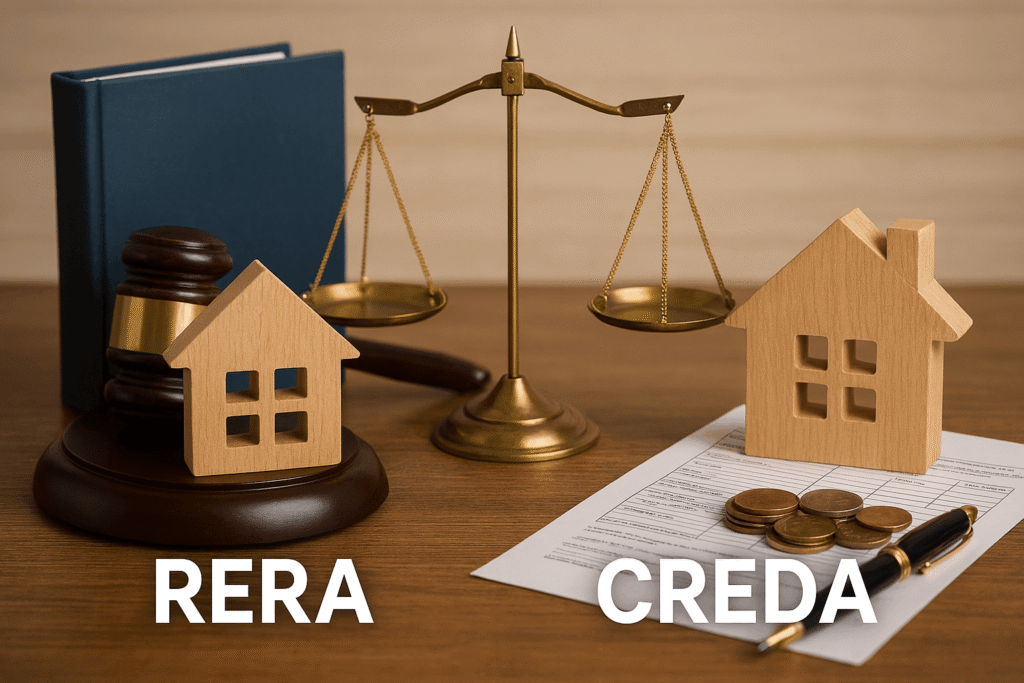

India’s real estate sector is one of the largest contributors to the economy. Yet, for years, homebuyers faced project delays, unclear contracts, and lack of accountability. To improve transparency and protect consumers, the government introduced the Real Estate (Regulation and Development) Act, 2016 (RERA Act India). At the same time, developers are often associated with CREDAI, a private industry body that frames internal standards for its members. Understanding RERA and CREDAI Guidelines is therefore essential for anyone trying to navigate property transactions and regulatory protections in India.
Because both RERA and CREDAI deal with real estate practices, many people assume they serve the same purpose. However, RERA and CREDAI Guidelines are fundamentally different in nature, authority, and legal impact. One is a statutory law, and the other is a voluntary association framework.
This article explains the difference in clear, simple terms for homebuyers, property investors, and general readers interested in real estate regulation India.
What is RERA?
RERA stands for the Real Estate (Regulation and Development) Act, 2016, a central law enacted by the Parliament of India. Its main aim is to regulate the real estate sector and protect homebuyer rights India.
Each state and union territory has its own RERA Authority and Appellate Tribunal, formed under the Act.
Key Objectives of the RERA Act
-
Protect buyers from unfair practices
-
Ensure timely completion of projects
-
Promote transparency in property transactions
-
Standardize documentation and disclosures
-
Create a legal grievance redressal system
RERA applies to most residential and commercial real estate projects above a specified size threshold, unless exempted under the law.
Legal Nature of RERA
RERA is binding law. Developers, real estate agents, and certain project participants must comply. Failure to do so can lead to:
-
Monetary penalties
-
Interest liability
-
Project deregistration
-
Even imprisonment in serious cases
What is CREDAI?
CREDAI stands for the Confederation of Real Estate Developers’ Associations of India. It is a private, non-governmental industry body formed by real estate developers.
CREDAI aims to:
-
Represent the interests of builders and developers
-
Promote ethical business practices
-
Improve industry standards
-
Engage with government on policy issues
Membership in CREDAI is voluntary. A developer may choose to join or not join.
Nature of CREDAI Guidelines
CREDAI may issue:
-
Codes of conduct
-
Ethical practice guidelines
-
Self-regulatory standards
However, these guidelines do not have the force of law. They apply mainly as internal standards for member developers.
Core Difference: Law vs. Industry Body
| Aspect | RERA | CREDAI |
|---|---|---|
| Legal Status | Statutory law under Parliament | Private developers’ association |
| Authority | Government-backed regulatory authority | Industry self-regulation |
| Applicability | Mandatory for covered projects | Voluntary membership |
| Enforcement | Legal penalties, tribunals, courts | Internal disciplinary action |
| Purpose | Consumer protection and regulation | Industry representation and improvement |
This table shows that RERA and CREDAI Guidelines operate at very different levels.
Scope of Regulation
RERA’s Regulatory Scope
Under the RERA Act:
-
Projects above a certain size must be registered with RERA
-
Developers must disclose project details, approvals, timelines
-
70% of funds collected from buyers must be kept in a separate account
-
Carpet area definition is standardized
-
Agreements for sale must follow prescribed formats
RERA covers:
-
Developers
-
Real estate agents
-
Ongoing and new projects (with exceptions)
CREDAI’s Scope
CREDAI’s influence is limited to:
-
Its member developers
-
Ethical standards within the association
-
Industry training and awareness
It cannot:
-
Cancel a project
-
Impose statutory fines
-
Override government law
Consumer Protection: A Major Difference
Under RERA
RERA strongly focuses on homebuyer rights India. Buyers can:
-
File complaints before the RERA Authority
-
Claim compensation for delays
-
Seek refund with interest
-
Approach the Appellate Tribunal if unsatisfied
Sections such as Section 18 (compensation for delay) and Section 31 (complaints to authority) are key legal tools for buyers.
Under CREDAI
CREDAI may encourage members to resolve disputes fairly. However:
-
A buyer cannot enforce CREDAI guidelines like a law
-
Disputes still need to be taken to legal forums such as RERA, consumer courts, or civil courts
Thus, CREDAI’s role is supportive, not legally binding for consumers.
Transparency and Disclosures
RERA Requirements
RERA mandates detailed disclosures, including:
-
Approved plans and layouts
-
Project timelines
-
Land title status
-
Details of promoters and contractors
These must be uploaded on the official state RERA website. This promotes real estate regulation India through transparency.
CREDAI’s Role
CREDAI may promote transparent practices among members. Yet, these are:
-
Not uniform across India
-
Not legally enforced like RERA disclosures
Accountability and Penalties
RERA Penalties
The Act provides for strict consequences:
-
Penalties for non-registration
-
Interest liability for delay
-
Daily fines for non-compliance
-
Possible imprisonment under serious violations
These powers come directly from the statute.
CREDAI Discipline
CREDAI can:
-
Warn or suspend members
-
Take internal action
But it cannot:
-
Impose statutory fines
-
Order legal compensation
Role in Policy and Industry Development
RERA
RERA authorities:
-
Regulate projects
-
Adjudicate disputes
-
Maintain project databases
They act as regulators under law.
CREDAI
CREDAI:
-
Represents developers before government
-
Participates in policy discussions
-
Conducts training and awareness programs
It acts as an industry voice, not a regulator.
Practical Tips for Homebuyers
When buying property:
-
Check RERA Registration
Always verify if the project is registered with the state RERA authority. -
Review RERA Disclosures
Look at approvals, timelines, and status updates on the RERA portal. -
Understand the Agreement for Sale
RERA standardizes key terms, including carpet area. -
Do Not Rely Only on Association Membership
A developer being a CREDAI member does not replace legal compliance with RERA. -
Use Legal Forums for Disputes
Complaints relating to delay or misrepresentation should go to RERA or other legal forums.
Legal Framework References
-
The Real Estate (Regulation and Development) Act, 2016
-
State RERA Rules and Regulations
-
Consumer Protection Act, 2019 (in some property disputes)
-
Indian Contract Act, 1872 (general contractual principles)
CREDAI guidelines do not replace these laws.
Common Misunderstandings
Myth 1: CREDAI approval equals legal approval
Not correct. Only statutory approvals and RERA registration have legal value.
Myth 2: RERA applies only to big cities
RERA is applicable across states and union territories, subject to local rules.
Myth 3: CREDAI can solve all disputes
It may help informally, but legal enforcement lies with statutory bodies.
FAQs on RERA and CREDAI Guidelines
1. Is CREDAI a government body?
No. CREDAI is a private association of developers.
2. Is RERA registration compulsory?
Yes, for projects that meet the criteria under the Act and state rules.
3. Can I file a case against a developer in CREDAI?
CREDAI is not a court or tribunal. Legal complaints must go to RERA or other legal forums.
4. Does CREDAI membership guarantee project quality?
Membership may reflect certain standards, but legal protection comes from RERA and other laws.
5. Which is more important for buyers: RERA or CREDAI?
From a legal point of view, RERA is more important because it provides enforceable rights.
Understanding RERA and CREDAI Guidelines is crucial for anyone dealing with property in India. RERA is a statutory law focused on consumer protection, transparency, and accountability. It creates enforceable rights and legal remedies. CREDAI, in contrast, is an industry association that promotes ethical practices among developers but does not have the power of law.
For homebuyers, RERA is the primary legal safeguard under real estate regulation India. CREDAI’s role is supportive and industry oriented. Knowing this difference helps individuals make informed property decisions without confusion about legal authority.