
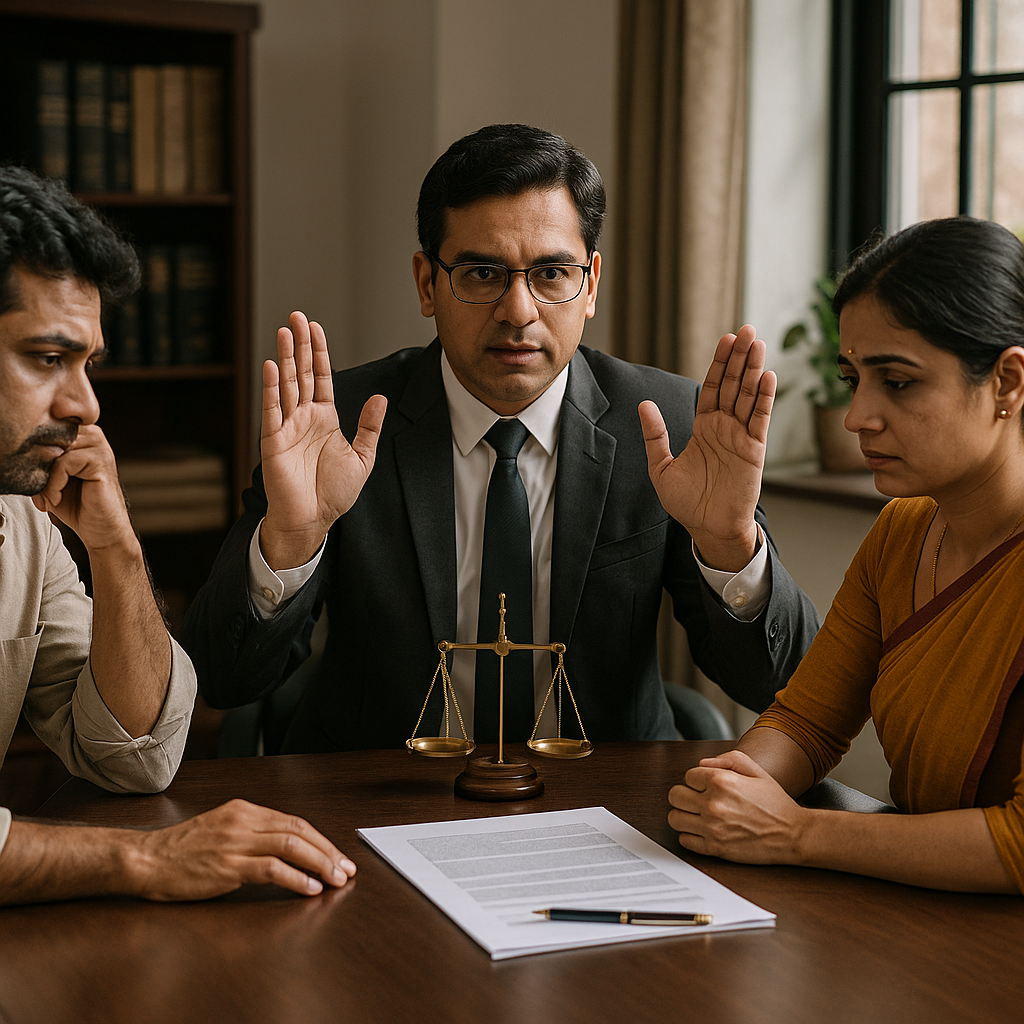

Divorce in India is rarely a straightforward affair. If you’ve ever waited outside a crowded family court in Delhi, Mumbai, or Bangalore, you’ve probably seen frustrated couples, worried parents, and lawyers shuffling thick files. Most people expect that once they file, things will move quickly. Instead, cases drag on for months – sometimes years – before even reaching a judge. So, what’s really stalling these divorce cases before they see the inside of a courtroom? The answer, more often than we admit, comes down to how we ignore or misunderstand the role of divorce mediation in India.
A lot of families don’t even know that mediation exists as an option. Or, they think it’s just a formality before the real fight begins. That lack of awareness and trust in the legal mediation process is costing families time, money, and peace. If you’re stuck or dreading your next hearing, this article will explain why most divorce cases stall and how mediation could bring a better outcome.
Quick Answer:
Most divorce cases in India stall before court due to delays in negotiation, emotional conflict, and lack of awareness about divorce mediation India offers. Mediation provides a faster, less adversarial, and more cost-effective way to resolve family disputes, often resulting in amicable divorce solutions and out-of-court settlements. Choosing a qualified family law mediator can help couples reach agreements on property, custody, and support, avoiding lengthy court battles.
Why Do Divorce Cases Stall Before Court?
The average Indian divorce case doesn’t stall because of a rare legal twist. It’s usually a mix of practical and emotional hurdles. Let’s look at what really causes the slowdowns:
Misunderstanding the Legal Process
- Many couples expect courts to instantly solve everything. In reality, the legal mediation process is built to encourage negotiation first.
- Family courts often recommend or require mediation before hearing the case.
- If neither party is prepared for this, valuable time gets wasted in repeated adjournments or failed counseling sessions.
Emotional and Cultural Barriers
- Divorce negotiation isn’t just about law. Anger, mistrust, and family pressure often stall talks before they begin.
- In Indian society, stigma around divorce can lead to hesitation, secrecy, or even sabotage of the process.
- Sometimes, one spouse refuses to cooperate, hoping the other will give up or agree to unfair terms.
Overreliance on Litigation
- Many believe only a judge can give a real solution. This mindset ignores the benefits of out-of-court settlement.
- Lawyers may focus on legal points but not on the underlying relationship dynamics or practical needs.
- As a result, paperwork gets stuck, hearings get postponed, and nothing moves forward.
Lack of Awareness About Mediation
- Few couples know about divorce mediation India offers under Section 9 of the Family Courts Act, 1984 and related High Court mediation centers.
- Even when mediation is suggested, parties may see it as a box to tick, not a genuine chance to resolve issues.
Honestly, if more families understood mediation, the waiting rooms would be a lot emptier.
What Is Divorce Mediation in India?
Divorce mediation is a structured, voluntary process where a neutral family law mediator helps couples work out their disputes. Instead of arguing in front of a judge, you sit across the table (sometimes literally, sometimes virtually) and talk through issues with the mediator’s help.
Key Features of Divorce Mediation India
- Voluntary and Confidential: Both parties must agree to participate. What’s said in mediation stays private and can’t be used in court unless both sides allow it.
- Mediators Are Trained Professionals: Most court-approved mediators have legal or counseling backgrounds. They’re trained to guide family dispute resolution without taking sides.
- Covers All Major Issues: Mediation can handle property division, child custody, maintenance, visitation, and even pet custody in some cases.
- Flexible Scheduling: Sessions are often arranged around the parties’ convenience, not the court’s calendar.
Legal Framework and Authority
- The Family Courts Act, 1984, and Section 89 of the Code of Civil Procedure require courts to refer suitable disputes to mediation or other alternative dispute resolution (ADR) mechanisms.
- Many High Courts (Delhi, Bombay, Karnataka, Madras, etc.) run their own mediation centers.
- Agreements reached in mediation can be recorded as a Memorandum of Understanding (MoU) and submitted to the court for legal recognition.
How Does the Legal Mediation Process Work?
The legal mediation process in India isn’t just a casual chat. It follows a clear structure, with defined steps and safeguards.
Typical Steps in Divorce Mediation India
- Referral: Court refers the divorcing couple to mediation, or parties choose it privately.
- First Meeting: Both parties meet the mediator, who explains the process and ground rules.
- Information Gathering: Each spouse shares their side, issues, and concerns. Mediator may ask for documents (property papers, salary slips, etc.).
- Issue Identification: The mediator helps both parties list out all points of dispute – assets, liabilities, custody, maintenance, etc.
- Negotiation Sessions: Through joint and separate meetings, the mediator helps find middle ground and clarify misunderstandings.
- Drafting Agreement: Once consensus is reached, the mediator drafts a settlement agreement or MoU.
- Court Approval: The agreement is submitted to the family court, which reviews and formalizes it as a court order.
What Makes Mediation Different from Court Hearings?
- Mediation is about cooperation, not confrontation. The focus is on finding solutions both sides can live with, not on proving who’s right.
- The mediator doesn’t make decisions. They guide the discussion and help break deadlocks.
- Sessions are private, with far less paperwork and no public record.
Timeframes and Costs
- Most mediations wrap up in 2 – 5 sessions over a few weeks. Some finish in a single day, others may take a couple of months.
- Costs are usually much lower than full-scale litigation. Some court-annexed mediation centers charge minimal fees or none at all.
- Private mediators may charge by the hour or session, often ranging from Rs 2,000 to Rs 10,000 per session, depending on city and experience.
Mediation Benefits vs. Court Battles
Why should you even consider mediation when you can take your fight to court? Here’s a practical comparison:
Mediation Benefits
- Faster Resolution: Court cases can drag for years, while mediation often finishes within weeks or months.
- Cost-Effective: Lower lawyer fees, fewer court visits, and less lost work time.
- Control Over Outcome: You decide your own settlement, unlike a judge’s order.
- Privacy: No public hearings or records; sensitive details stay confidential.
- Better Relationships: Mediation can preserve a working relationship, important when kids or joint businesses are involved.
Drawbacks of Litigation
- Delays: Indian courts are overloaded. Adjournments are common.
- High Costs: Legal fees, travel, and lost wages add up quickly.
- Stress and Hostility: Court battles can worsen animosity, making co-parenting or future interactions harder.
- Unpredictable Outcomes: Judges may give decisions that satisfy neither party.
Table: Mediation vs. Court Litigation in Divorce Cases
| Factor | Mediation | Court Litigation |
|---|---|---|
| Time | Weeks to months | 1 – 5 years (often longer) |
| Cost | Low to moderate | High |
| Privacy | High | Low |
| Control | Parties decide | Judge decides |
| Relationship Impact | Often improves | Usually worsens |
| Enforceability | High (if court-approved) | High |
Common Reasons Mediation Fails (and How to Avoid Them)
Not every mediation succeeds. Still, many failures can be traced to avoidable mistakes. Here’s what tends to go wrong:
Lack of Preparation
- Parties arrive without clear goals or required documents.
- Some think mediation is just a formality, so they don’t take it seriously.
Power Imbalance
- One spouse dominates the conversation, or the other feels intimidated.
- Mediators are trained to spot and manage this, but both parties need to speak up if they feel unheard.
Hidden Agendas or Bad Faith
- Sometimes, a party uses mediation to stall or gather information for court.
- If there’s no real intent to settle, mediation will likely fail.
Unresolved Emotional Issues
- Grief, anger, or betrayal can block logical negotiation.
- Sometimes a short break or support from a counselor helps.
How to Improve Your Chances
- Come prepared with all facts and documents.
- Be honest about your priorities and limits.
- Choose a mediator with experience in family dispute resolution.
- If you feel unsafe or bullied, let the mediator know immediately.
Who Can Be a Family Law Mediator?
Not everyone calling themselves a mediator is qualified. In India, family law mediators are typically:
- Practicing advocates with at least 10 years’ experience.
- Retired judges or senior lawyers empanelled by High Court mediation centers.
- Trained professionals with a background in counseling, psychology, or social work (less common, but growing).
How to Choose the Right Mediator
- Check if they are registered with a court-annexed mediation center (like Delhi High Court Mediation and Conciliation Centre).
- Ask about their experience with divorce negotiation and related issues (property, custody, maintenance).
- Look for someone who explains the process clearly and remains neutral.
Mediation and Indian Family Laws: What Do You Need to Know?
Mediation is not a replacement for legal rights, but it works within the Indian legal system. Here are some important legal aspects:
Statutory Provisions Supporting Mediation
- Section 9, Family Courts Act, 1984: Encourages settlement through counseling and mediation before proceeding with litigation.
- Section 89, Code of Civil Procedure, 1908: Courts must refer cases to ADR, including mediation, where possible.
- Supreme Court Guidelines: In cases like Afcons Infrastructure Ltd. v. Cherian Varkey Construction Co. (2010), the Supreme Court clarified that family disputes are suitable for mediation.
What Issues Can Be Mediated?
- Property Division: Ancestral, joint, and self-acquired assets can be discussed.
- Child Custody and Visitation: Detailed parenting plans can be worked out.
- Maintenance and Alimony: Spousal and child support amounts and payment schedules.
- Debt and Liabilities: Division of loans or credit card balances.
What Cannot Be Mediated?
- Criminal allegations (such as Section 498A IPC) are generally not mediated.
- Issues involving domestic violence may require special handling or court intervention.
Enforceability of Mediation Agreements
- Mediation outcomes are written as an MoU and submitted to the court.
- The court reviews the terms to ensure fairness and legality.
- Once accepted, the agreement becomes a binding court order.
Real Examples: How Mediation Helped Indian Families
While privacy rules prevent naming names, here are some typical scenarios seen in mediation centers across India:
Example 1: Property and Maintenance Dispute
A couple in Pune was fighting over a 2BHK flat, gold jewelry, and monthly maintenance. In court, tempers ran high and neither budged. In mediation, with both parties’ parents present, they agreed the wife would keep the flat and jewelry, while the husband would pay maintenance for two years only. Both saved years of court battles.
Example 2: Child Custody Negotiation
A Bengaluru couple struggled with shared custody. The mother wanted weekends, the father wanted festivals. Mediation sessions helped them draft a calendar – alternate weekends, split holidays, and daily video calls. The court accepted their plan, and the child avoided being caught in the middle.
Example 3: Business Ownership Split
A Delhi couple ran a family business. Mediation helped them value their shares, agree on a buyout, and even set rules for future contact. No judge could have crafted such a detailed, practical deal.
When Is Mediation Not the Right Choice?
Mediation is powerful, but it’s not a magic fix for every situation. Some cases are better suited for court:
- Domestic Violence: If there’s ongoing abuse or threats, mediation may not be safe or appropriate.
- Serious Mental Health Issues: When one spouse cannot participate rationally, the process may fail.
- Complete Breakdown of Communication: If neither party will talk or negotiate, mediation stalls.
- Hidden Assets or Fraud: Mediation relies on honesty. If one side hides income or property, the process can’t work.
Judges and mediators are trained to spot these red flags and will refer such cases back to court.
How to Start Divorce Mediation in India
If you think mediation might help, here’s what to do:
- Ask Your Lawyer: Many lawyers now recommend mediation first. If yours doesn’t, ask why not.
- Contact a Court Mediation Center: Almost every major city has one linked to the family court. Walk in or call to ask about the process.
- Choose a Private Mediator: If both parties agree, you can hire a private mediator. Ensure they’re qualified in family dispute resolution.
- Prepare Your Documents: Bring property papers, salary slips, loan statements, and any other relevant records.
- Set Your Priorities: Decide what you want, where you can compromise, and what you can’t accept.
- Attend Sessions: Be honest and open, but also willing to listen.
Most people overthink the first step. Just asking about mediation can open doors to faster, less painful solutions.
Frequently Asked Questions
What is divorce mediation in India?
Divorce mediation in India is a voluntary process where a neutral family law mediator helps divorcing couples negotiate settlements on issues like property, custody, and maintenance. It is recognized and encouraged by Indian courts as a way to resolve disputes outside lengthy litigation.
How is mediation different from court divorce proceedings?
Mediation is private, faster, and less formal than court proceedings. The parties control the outcome, and sessions focus on discussion, not arguments. Court litigation is public, slow, and the judge makes the final decision.
What are the main benefits of mediation in Indian divorce cases?
The main mediation benefits include lower costs, faster resolution, privacy, and solutions tailored to both parties’ needs. Mediation often reduces hostility and helps maintain a working relationship, especially when children are involved.
Is a mediation agreement legally binding in India?
Yes. Once the mediation settlement is recorded as a Memorandum of Understanding (MoU) and accepted by the court, it becomes a binding order. Both parties are legally required to follow its terms.
Who can act as a family law mediator in India?
Family law mediators are usually experienced lawyers, retired judges, or professionals trained and empanelled by court mediation centers. Check if your mediator is registered with a recognized institution or court program.
What issues can be resolved through divorce mediation?
Divorce mediation can resolve property division, child custody and visitation, maintenance and alimony, and division of debts. Criminal allegations and certain abuse cases are usually excluded.
How long does divorce mediation usually take in India?
Most mediations conclude within 2 – 5 sessions, spread over a few weeks. Complex cases may take longer, but it is still usually much faster than court litigation.
What if one party refuses to participate in mediation?
If one spouse refuses mediation, the case will usually return to court for traditional litigation. Mediation is voluntary and requires both parties’ cooperation.
How much does divorce mediation cost in India?
Court-annexed mediation is often free or charges a nominal fee. Private mediators may charge between Rs 2,000 and Rs 10,000 per session, depending on city and experience.
What happens if mediation fails?
If mediation does not result in an agreement, the case proceeds to court. Discussions in mediation remain confidential and cannot be used as evidence unless both sides agree.
Does mediation work in cases involving child custody?
Yes, mediation is especially effective for child custody and visitation arrangements. Parents can create detailed, flexible schedules that a court may not have time to design.
Can I bring my lawyer to mediation sessions?
Yes, you can bring your lawyer to mediation, but many sessions work best when parties speak directly. Lawyers can advise before and after sessions, and attend if necessary.
Conclusion
Many divorce cases in India stall before ever reaching court because families miss the chance to resolve issues through mediation. Divorce mediation India offers is not just a legal formality – it’s a practical, proven way to find amicable divorce solutions, save money, and protect your peace of mind. For most couples, understanding and trusting the legal mediation process can make all the difference between years of struggle and a dignified, workable settlement.