
Inheritance disputes in Chandigarh can turn families upside down. One sibling wants to sell the old house, another refuses. Someone shows up with a will, but the rest aren’t convinced it’s real. Suddenly, everyone’s talking about the Hindu Succession Act, probate, and who counts as a legal heir. If you’re worried about property succession rules or just trying to understand how ancestral property division works in this city, you’re not alone. Inheritance law in Chandigarh is a maze, and the way it shapes property division outcomes often leaves people confused, frustrated, or even in court for years.
If you want the bottom line: Inheritance law in Chandigarh determines how property is divided among heirs, whether through a will or by default under the Hindu Succession Act or other personal laws. The law covers who qualifies as a legal heir, how ancestral and self-acquired property is split, and what happens in will disputes. Probate and property transfer law also affect how fast (or slow) property actually gets transferred.
How Inheritance Law Works in Chandigarh
Chandigarh’s property division outcomes depend mostly on which law applies to the deceased. The city, known for its planned sectors and mix of Punjabi and Haryanvi families, sees everything from urban apartments to sprawling ancestral homes. The main frameworks are:
- Hindu Succession Act, 1956 (applies to Hindus, Sikhs, Jains, Buddhists)
- Indian Succession Act, 1925 (for Christians, Parsis, and those with registered wills)
- Muslim Personal Law (Shariat) Application Act, 1937 (for Muslims)
Personal Law Decides Property Succession Rules
Each community follows its own rules for property inheritance. In Chandigarh, about 80% of property matters fall under the Hindu Succession Act, but mixed marriages and interfaith families can complicate things.
- Hindus, Sikhs, Jains, Buddhists: Governed by the Hindu Succession Act
- Muslims: Inheritance governed by Shariat law, which divides property into shares for each heir
- Christians, Parsis: Indian Succession Act applies
If there’s a valid will, it overrides the default rules. But many families never make a formal will, so property is divided as per these laws.
Key Terms: Legal Heir, Ancestral Property, Self-Acquired Property
- Legal heir: The person(s) entitled by law to inherit property
- Ancestral property: Property inherited up to four generations, not divided by the family
- Self-acquired property: Property bought or earned by the deceased, not inherited
Understanding these terms is essential because the rules for dividing ancestral property are not the same as for self-acquired assets.
The Hindu Succession Act: Backbone of Chandigarh’s Property Division
The Hindu Succession Act (HSA), 1956 is the most-cited law for property division in Chandigarh. It lays out who inherits what, how much, and in what order.
Class I and Class II Heirs: Who Gets What?
If a Hindu dies intestate (without a will), the HSA divides heirs into classes:
- Class I heirs (get priority):
- Son
- Daughter
- Widow
- Mother
- Children of a predeceased son or daughter
- Class II heirs (considered only if no Class I heirs):
- Father
- Siblings
- Distant relatives (uncles, aunts)
For example, if a man in Chandigarh dies leaving a wife, two daughters, and a son, each child and the widow get equal shares. If there are only brothers and sisters, they come into play only if no wife, children, or mother survive.
Coparcenary Rights: Daughters’ Equal Share
Since 2005, daughters have the same rights as sons in ancestral property. This change has had a huge impact in Chandigarh, where earlier daughters often got nothing. Now, a daughter is a coparcener, meaning she can demand partition and her share even after marriage.
Ancestral vs Self-Acquired Property Division
- Ancestral property: All coparceners (sons and daughters) get equal shares. Grandchildren may also stake a claim if their parent (a son or daughter of the deceased) is no longer alive.
- Self-acquired property: The owner can will it to anyone. If no will, it passes as per the HSA to Class I heirs.
Key Exclusions and Exceptions
- Adopted children are treated as biological children.
- Stepchildren have no automatic rights unless adopted.
- Illegitimate children (if proven) can claim under some circumstances.
Wills, Will Disputes, and the Probate Process in Chandigarh
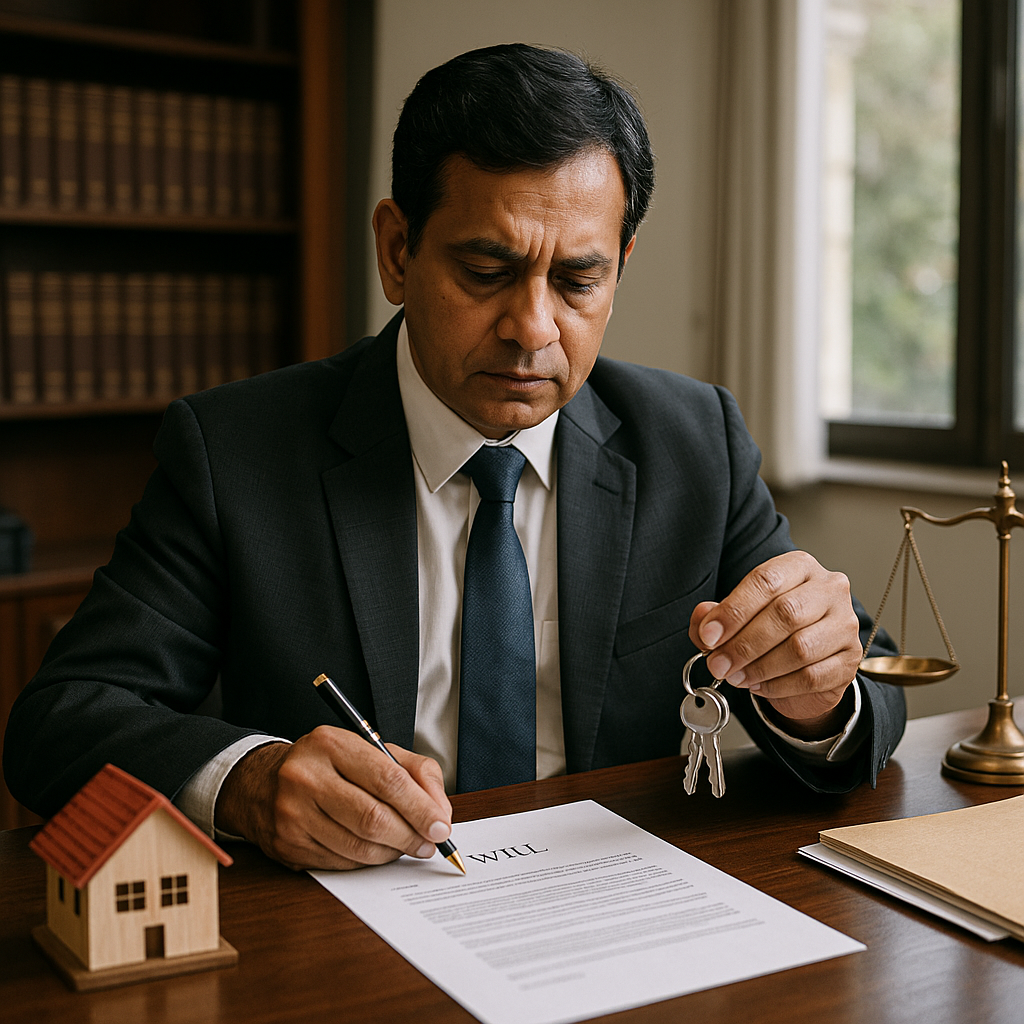
A registered will can override the default property succession rules. But in reality, will disputes are common in Chandigarh. Sometimes families find multiple wills, or one sibling claims the will is forged.
Requirements for a Valid Will
- Must be in writing (except for Muslims, where oral wills are possible in some cases)
- Signed by the testator (the person making the will)
- Witnessed by at least two people
Handwritten wills are accepted if they meet the above requirements, but registration adds legal weight. Unregistered wills often lead to disputes.
Common Will Disputes
- Allegations of forgery
- Claims of undue influence (elderly person pressured by a relative)
- Ambiguity in property description
- Missing or contradictory pages
Courts in Chandigarh see hundreds of will challenges each year. It’s not rare for property to be stuck in litigation for 5 – 10 years if heirs fight.
The Probate Process: Getting a Will Recognised
Probate is the legal process of proving a will’s validity in court. In Chandigarh, probate is mandatory for wills relating to immovable property if challenged.
- Application is filed in the district court.
- Notice sent to all legal heirs.
- Objections (if any) are heard.
- If the court is satisfied, probate is granted.
Probate can take anywhere from 6 months to 3 years, depending on objections and court workload.
Property Transfer Law: How Inheritance Becomes Ownership
Even after succession is settled, the property must be formally transferred to the heir’s name. Chandigarh’s property transfer law follows a clear process, but it’s rarely quick.
Steps for Property Transfer After Inheritance
- Collect the death certificate of the property owner.
- Obtain the legal heir certificate (from SDM or Tehsildar).
- Apply for mutation of property at the local municipal office.
- Submit required documents: will (if any), probate (if applicable), identity proof, and NOC from other heirs (if needed).
- Pay applicable transfer fees or stamp duty (usually minimal for inheritance transfers).
Mutation is what updates the official property records. Without it, you can’t sell or mortgage the property.
Common Delays and Issues
- Missing documents (old sale deeds, tax receipts)
- Disputes among heirs
- Objections from neighbours or relatives
- Backlog at the municipal office
Some people skip proper transfer, leading to trouble later. If you plan to sell inherited property, make sure mutation is done.
Special Rules for Ancestral Property Division in Chandigarh
Ancestral property is a hot topic in Chandigarh, especially among families with land or old houses in the region. The rules are strict, but not always clear to the average person.
What Counts as Ancestral Property?
- Property inherited by a male ancestor up to four generations
- Not divided by the family during that time
- Applies to Hindus, Sikhs, Jains, and Buddhists
If the property was sold, gifted, or divided at any stage, it stops being ancestral.
Coparcenary and Partition Rights
- All coparceners (sons and daughters) can demand partition
- Grandchildren can claim if their parent (a coparcener) is deceased
- If one heir refuses to sell or divide, others can file a partition suit in court
Limitations on Gift or Sale of Ancestral Property
A coparcener can’t sell or gift ancestral property without the consent of other coparceners. If someone tries, the other heirs can challenge the transaction in court. This is a frequent issue in Chandigarh, where a single sibling tries to sell family land without informing others.
Muslim and Christian Succession Laws in Chandigarh
While most cases involve the Hindu Succession Act, Chandigarh’s diverse population means other laws are also relevant.
Muslim Personal Law (Shariat)
- Property is divided into fixed shares among heirs: sons, daughters, wives, parents
- Sons get twice the share of daughters
- A Muslim can will away only up to one-third of property; the rest goes to heirs as per Shariat
No concept of ancestral property. All property is treated as self-acquired for succession.
Indian Succession Act (for Christians, Parsis)
- Property divided equally among widow, children, and mother
- If no children, widow gets half, the rest goes to other relatives
- Will must be in writing and signed by two witnesses
Recent Legal Developments and Chandigarh-Specific Practices
Chandigarh has seen some unique trends in property division cases:
- Rise in will disputes: As more people write wills, the number of challenges has increased. Courts often have to decide which will is genuine.
- Greater claims by daughters: Since the 2005 HSA amendment, daughters are more likely to demand their share, leading to more partitions.
- Urban vs rural property: Urban plots are easier to divide or sell. Ancestral land in neighbouring villages is harder, especially if records are missing or there are multiple claimants.
Some families try to resolve issues through mediation or by hiring lawyers who specialise in property division. For examples of real cases and how outcomes differ, see Outcomes That Matter: Real Stories from Chandigarh’s Property Division Cases.
Role of Courts and Lawyers in Chandigarh Property Disputes
Inheritance law in Chandigarh keeps the district courts and property division lawyers busy. Most disputes are settled only after a long legal process.
Common Types of Property Inheritance Cases
- Partition suits (one heir wants division, others refuse)
- Will probate applications
- Challenges to mutation or property transfer
- Disputes over forged documents or missing records
How Lawyers Help
- Drafting and registering wills
- Applying for probate or succession certificates
- Filing and defending partition suits
- Negotiating settlements among heirs
Hiring a lawyer who specialises in property division can save years of delay. For more on how professionals approach these cases, check Property Division Lawyers in Chandigarh: Setting the Standard for Fair Settlements.
Practical Mistakes and Best Practices in Chandigarh’s Inheritance Cases
Many Chandigarh families repeat similar mistakes when dealing with inherited property. Here’s what usually goes wrong:
- Not making a will, assuming the family will sort it out
- Failing to register the will, making it easier to challenge
- Ignoring mutation or property transfer paperwork
- Overlooking the rights of married daughters
- Relying on verbal promises instead of legal documents
How to Avoid Common Pitfalls
- Always draft a clear, specific will and register it
- Keep all property and identity documents in order
- Apply for legal heir and succession certificates promptly
- Consult a property lawyer if there’s any doubt or dispute
Frequently Asked Questions
What is the difference between ancestral and self-acquired property under inheritance law in Chandigarh?
Ancestral property is inherited up to four generations and not divided by the family, while self-acquired property is bought or earned by the individual. Inheritance rules differ: ancestral property is divided equally among all coparceners, while self-acquired property can be willed to anyone or divided among legal heirs if there is no will.
Who qualifies as a legal heir for property inheritance in Chandigarh?
Legal heirs are defined by the personal law applicable to the deceased. Under the Hindu Succession Act, Class I heirs include spouse, children, and mother. For Muslims, fixed shares are given to sons, daughters, spouse, and parents as per Shariat law.
How is property divided if there is no will in Chandigarh?
If there is no will, property is divided according to succession laws based on the religion of the deceased. For Hindus, the Hindu Succession Act applies, giving equal shares to all Class I heirs. For Muslims and Christians, different personal laws govern the division.
What is the probate process for a will in Chandigarh?
Probate is the legal validation of a will by a court. The process involves:
1. Filing a probate application in district court.
2. Notifying all legal heirs.
3. Hearing objections if any.
4. Granting probate if the will is found genuine.
This process can take several months or longer if contested.
Can daughters claim a share in ancestral property in Chandigarh?
Yes, daughters have equal rights as sons in ancestral property under the Hindu Succession Act after the 2005 amendment. They can demand partition and claim their share even after marriage.
How can one challenge a will in Chandigarh?
A will can be challenged on grounds of forgery, undue influence, lack of mental capacity, or improper execution. The challenger needs to file a suit in the appropriate court and provide evidence supporting their claim.
What documents are needed to transfer inherited property in Chandigarh?
The main documents required are:
– Death certificate of the deceased
– Legal heir certificate
– Will and probate order (if applicable)
– Identity proof of heirs
– NOC from other heirs (if necessary)
– Mutation application form
How is property succession different for Muslims in Chandigarh?
Muslims follow Shariat law, which divides property into fixed shares among heirs. Sons get twice the share of daughters, and only one-third of the property can be given by will. There is no concept of ancestral property as in Hindu law.
What happens if a property owner dies without legal heirs in Chandigarh?
If no legal heirs exist, the property may escheat to the government after due legal process. This is rare but possible if all eligible relatives are deceased or untraceable.
Is it necessary to register a will in Chandigarh?
Registration is not mandatory but is recommended. A registered will is harder to challenge in court and provides stronger legal proof of the testator’s intent.
How long does it take to resolve property succession cases in Chandigarh?
Simple cases with no disputes can be completed in 6 – 12 months. Contested cases, especially those involving will disputes or ancestral property, may take several years.
Can a single heir sell inherited property without others’ consent in Chandigarh?
If the property is jointly inherited, all co-owners must consent to sell. An individual cannot sell the entire property without the agreement of other legal heirs or coparceners.
Conclusion
Inheritance law in Chandigarh is shaped by a mix of personal laws, statutory acts, and real family dynamics. The way property gets divided depends on whether there’s a valid will, the type of property, and the rights of legal heirs under current law. Will disputes, the probate process, and property transfer law all affect how fast heirs can take ownership. Understanding these rules – and avoiding common mistakes – can save years of conflict and legal bills. If you’re facing property division after a family member’s death, a clear grasp of inheritance law in Chandigarh is your best starting point.