
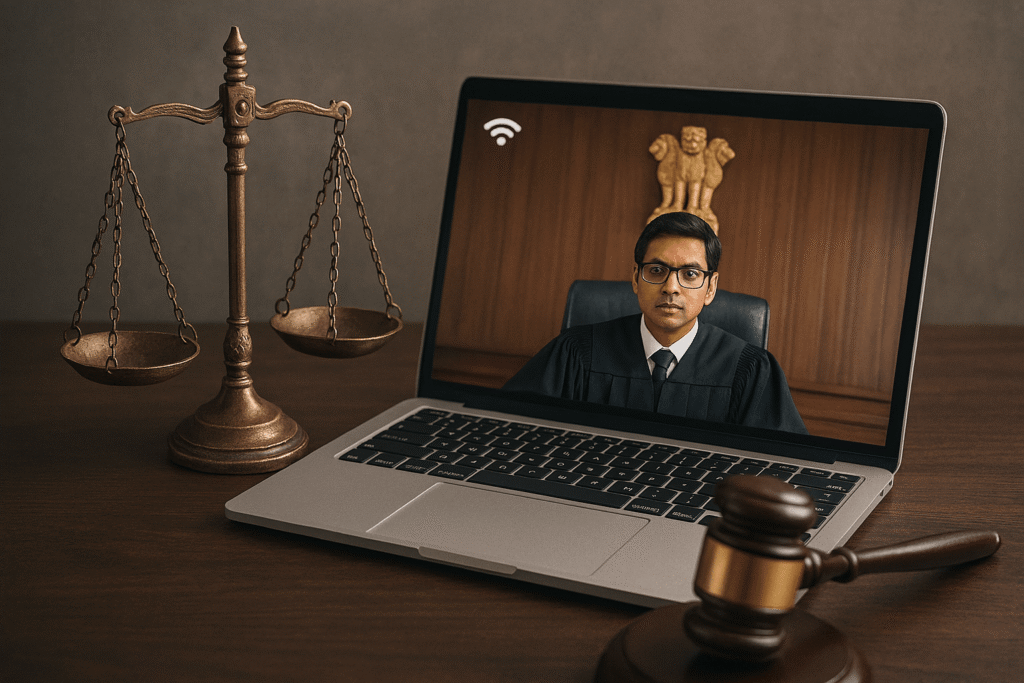

For many Non Resident Indians (NRIs), dealing with legal matters in India once meant frequent travel, high costs, and long delays. Court appearances required physical presence. Document filing was paper based. Communication was slow. Today, this situation is changing. Digital systems, online court services, and virtual hearings are improving NRI Legal Access in India. Indian courts now use technology to make justice more accessible, efficient, and transparent.
These reforms are supported by judicial policies, statutory provisions, and Supreme Court-approved guidelines. As a result, NRIs can now participate in virtual court hearings in India, file cases through e-courts India systems, and manage disputes especially NRI property disputes in India with fewer physical visits.
This article explains how technology is reshaping legal access for NRIs, the laws behind it, and what it means in practice.
Understanding NRI Legal Access in India
NRI Legal Access in India refers to the ability of Indians living abroad to:
-
File and defend cases in Indian courts
-
Participate in hearings
-
Submit evidence and documents
-
Give statements or testimony
-
Handle property, family, and civil disputes
Traditionally, distance was a major barrier. However, constitutional principles such as access to justice (linked to Article 14 and Article 21 of the Constitution of India) require that legal systems be fair and reasonably accessible.
Technology now helps courts meet this objective.
The Rise of E-Courts India
What Are E-Courts?
The e-Courts Project, launched under the National e-Governance Plan, aims to computerize Indian courts. It is supervised by the e-Committee of the Supreme Court of India.
The project includes:
-
Online case status systems
-
Digital cause lists
-
Electronic filing (e-filing)
-
Virtual court infrastructure
-
Digital records
These steps reduce dependence on physical court processes. This shift directly benefits NRI Legal Access in India.
Legal Basis for Virtual Court Hearings in India
Virtual hearings are not informal arrangements. They are supported by law and judicial directions.
1. Supreme Court and High Court Powers
Under Article 145 of the Constitution, the Supreme Court can frame rules for its procedure. High Courts have similar rule-making powers under Article 225 and the Code of Civil Procedure, 1908 (CPC) and Code of Criminal Procedure, 1973 (CrPC).
2. Video Conferencing Rules
The Supreme Court’s e-Committee issued Model Video Conferencing Rules for courts. Many High Courts have adopted these with modifications. These rules allow:
-
Recording of evidence through video conferencing
-
Virtual presence of parties and witnesses
-
Remote participation of lawyers
This framework strengthens virtual court hearings in India.
3. Recognition of Electronic Records
Under the Information Technology Act, 2000, electronic records and digital signatures have legal recognition.
Further, Section 65B of the Indian Evidence Act, 1872 allows electronic records to be admitted as evidence, subject to conditions. This is important when NRIs submit digital documents from abroad.
How Virtual Hearings Improve NRI Legal Access in India
1. Reduced Need for Travel
NRIs often live in different time zones and countries. Earlier, even short hearings required travel to India.
Now, courts permit:
-
Appearance through video conferencing
-
Remote interaction with the court
-
Online monitoring of case progress
This makes legal participation more practical.
2. Faster Communication
Digital systems allow:
-
Electronic service of notices in some cases
-
Email communication from courts
-
Online access to orders and judgments
NRIs no longer depend only on physical copies or intermediaries.
3. Better Case Tracking
Through e-courts India portals, parties can check:
-
Case status
-
Next hearing dates
-
Orders passed
-
Case history
This transparency improves trust in the system and supports NRI Legal Access in India.
E-Filing and Digital Documentation
What Is E-Filing?
E-filing allows litigants or authorized representatives to submit:
-
Pleadings
-
Applications
-
Affidavits
-
Documents
through online court systems.
Legal Support
Procedural laws such as the CPC allow courts to regulate filing processes. High Courts have framed e-filing rules under their rule making powers.
For NRIs, this means:
-
Documents can be prepared abroad
-
Scanned copies can be uploaded
-
Digital signatures may be used, where permitted
This reduces delays and postal issues.
Technology and NRI Property Disputes in India
Property matters are among the most common legal issues faced by NRIs.
These include:
-
Illegal occupation
-
Partition disputes
-
Title disputes
-
Misuse of Power of Attorney
Technology plays a major role here.
1. Online Land Records
Many states offer digitized land records. While these are not always final proof of title, they help NRIs:
-
Verify ownership details
-
Track changes in records
-
Detect suspicious entries
2. Virtual Hearings in Property Cases
In civil suits related to property, courts may allow:
-
Virtual appearances
-
Recording of evidence through video conferencing
This is particularly useful when the NRI is a key party or witness.
3. Digital Evidence
Emails, messages, and electronic transactions related to property dealings can be used as evidence under Section 65B of the Evidence Act.
This strengthens NRI Legal Access in India in property disputes.
Role of Power of Attorney in a Digital Era
Many NRIs use a Power of Attorney (PoA) to manage legal matters in India.
Legal Framework
A PoA is governed by the Powers of Attorney Act, 1882, and relevant provisions of the Indian Contract Act, 1872.
Technology Support
Now, NRIs can:
-
Draft PoA documents abroad
-
Get them notarized or attested as per Indian requirements
-
Send scanned copies for initial processes (originals may still be required later)
Digital communication also helps monitor how the PoA holder is acting.
Technology in Family and Personal Law Matters
NRIs are often involved in:
-
Divorce cases
-
Child custody disputes
-
Maintenance proceedings
Courts increasingly allow:
-
Virtual hearings for personal appearances
-
Online submission of documents
-
Remote testimony
However, courts may still require physical presence in certain stages, depending on facts and law.
Safeguards and Fairness in Virtual Hearings
Technology must not affect fairness. Courts follow safeguards.
1. Identity Verification
Courts verify the identity of parties and witnesses appearing virtually.
2. Recording of Proceedings
Virtual hearings are recorded. This maintains transparency and accountability.
3. Judicial Discretion
Judges decide whether a case is suitable for video conferencing. Sensitive matters may require physical hearings.
These safeguards ensure that virtual court hearings in India remain consistent with natural justice principles.
Challenges Still Faced by NRIs
Despite progress, some issues remain.
-
Internet connectivity problems
-
Time zone differences
-
Technical literacy gaps
-
Need for physical documents in some stages
Also, not all courts or districts are equally digitized.
However, the overall trend strongly supports improved NRI Legal Access in India.
Practical Points NRIs Should Know
While each case is different, NRIs should generally be aware that:
-
Many courts allow virtual appearances, subject to rules
-
Electronic records can be valid evidence
-
E-filing systems are expanding
-
Courts may still require originals later
-
Procedural rules vary between courts
These points show how technology supports participation but does not remove all formalities.
Legal References Supporting Digital Access
Key laws and frameworks include:
-
Constitution of India (Articles 14, 21, 145)
-
Code of Civil Procedure, 1908
-
Code of Criminal Procedure, 1973
-
Information Technology Act, 2000
-
Indian Evidence Act, 1872 (Section 65B)
-
Powers of Attorney Act, 1882
-
Supreme Court and High Court Video Conferencing Rules
-
e-Courts Project policies
These collectively support technology driven NRI Legal Access in India.
FAQs on NRI Legal Access in India
1. Can NRIs attend Indian court hearings from abroad?
In many cases, yes. Courts may permit appearance through video conferencing, depending on the nature of the case and applicable rules.
2. Are virtual court hearings in India legally valid?
Yes. They are supported by court rules, judicial directions, and procedural laws. However, judges decide suitability on a case-by-case basis.
3. Can electronic documents be used as evidence?
Yes, electronic records can be admitted under Section 65B of the Indian Evidence Act, subject to required certification and conditions.
4. Do NRIs still need to travel to India for legal cases?
In some situations, travel may still be necessary. However, technology has reduced the number of required physical appearances in many cases.
5. How do e-courts India systems help NRIs?
They allow online case tracking, access to orders, and in some courts, e-filing of documents. This improves transparency and convenience.
6. Are virtual hearings used in NRI property disputes in India?
Yes. Courts may use video conferencing in civil property cases, especially for recording evidence or appearances of parties living abroad.
Technology is reshaping the Indian judicial system. Digital platforms, e-filing, and virtual court hearings in India are making legal processes more accessible to people living outside the country.
For NRIs, these reforms significantly improve NRI Legal Access in India. They reduce travel, increase transparency, and allow better participation in cases, including NRI property disputes in India.
At the same time, courts maintain procedural safeguards to ensure fairness and reliability. While challenges remain, the direction is clear: technology is becoming an essential tool in ensuring access to justice for NRIs under Indian law.