

Property disputes in Chandigarh can quickly drain your time, money, and peace of mind. Many people rush to property dispute mediation thinking it’s always faster and cheaper than court, but the reality is far more complicated. Costs can spiral, settlements may not stick, and the process itself brings its own risks. If you’re caught in a real estate fight – whether it’s a family partition or a builder-buyer clash – understanding the myths and facts about mediation could save you from expensive mistakes.
If you think property dispute mediation in Chandigarh is always the fastest and cheapest way out, you might be surprised. While mediation can help settle real estate disputes without a full trial, it’s not always less expensive or less stressful. Factors like mediator fees, enforceability of settlement agreements, and failed negotiations can mean more time and money than you expect.
The Promise and Reality of Property Dispute Mediation
Most people hear about property dispute mediation from friends, lawyers, or builders who promise a quick, out-of-court fix. Mediation is a type of alternative dispute resolution (ADR) where a neutral third party helps both sides talk and (hopefully) agree. But in Chandigarh’s real estate world, the ground realities are not so simple.
Mediation’s popularity has grown thanks to clogged courts and the hope of saving face within families or business circles. The cost of mediation is often advertised as lower than litigation, but this depends on many things: the mediator’s fee, how many sessions you need, and whether you actually settle. If talks fail, you might end up in court anyway – paying for both processes. For a deeper look at how these disputes unfold locally, see Resolving Property Disputes in Chandigarh: A Strategic Playbook for Owners and Heirs.
Mediation vs. Litigation: What’s Really Cheaper?
Many assume mediation is always the budget option. But in Chandigarh, real estate mediation can sometimes cost as much as a short court case. Private mediators set their own fees, and even court-annexed mediation (where the court refers cases to a panel mediator) involves costs for documentation, legal help, and sometimes repeated sessions.
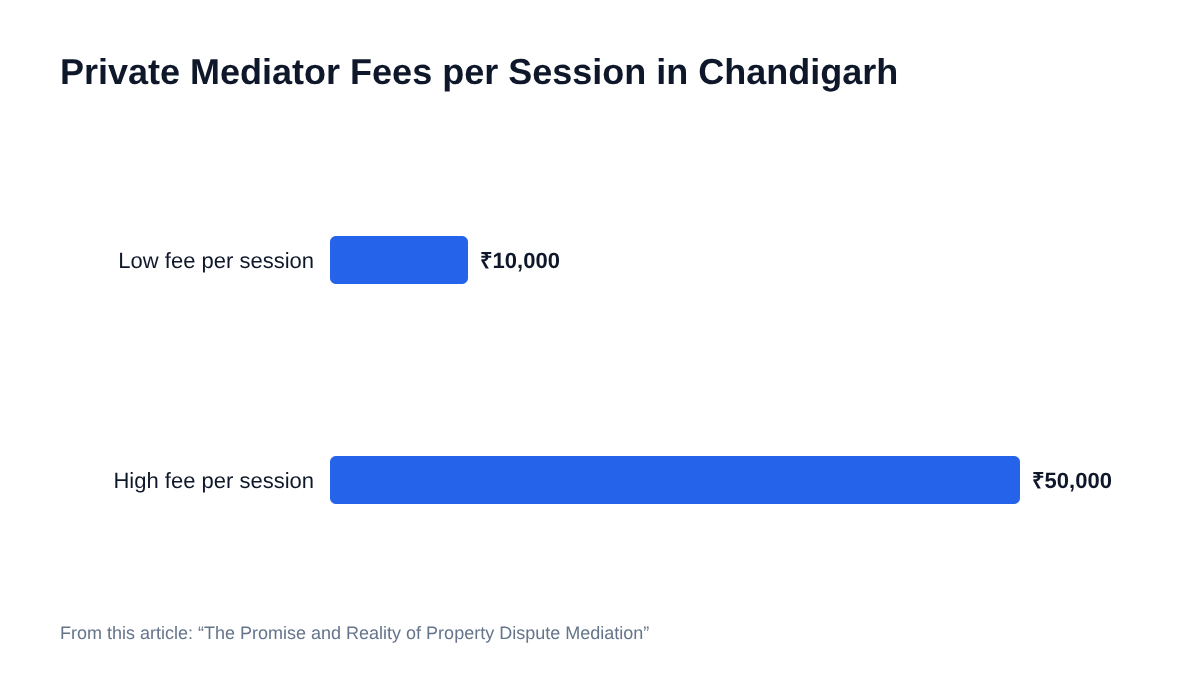
A typical private mediator in Chandigarh may charge anywhere from ₹10,000 to ₹50,000 per session, depending on experience and the dispute’s complexity. If you need 4-5 sessions (not unusual for family property partitions), you could spend ₹2 lakh or more before reaching a settlement agreement. In contrast, a simple civil suit in the District Court could be resolved in as little as six months – if both sides cooperate and the facts are clear. Of course, most cases drag on much longer, but the point is, mediation is not always the clear winner on cost or speed.
When Mediation Makes Sense (and When It Doesn’t)
Not every property dispute is fit for mediation. Disputes over straightforward documentation errors, forged signatures, or cases with criminal elements often go straight to litigation. Mediation is best for cases where both sides are open to compromise, such as:
- Partition of joint family properties where relationships still exist.
- Builder-buyer disputes over delays or handover issues.
- Boundary or easement disagreements between neighbours.
- Commercial lease disputes where ongoing business is at stake.
But if either party is purely interested in winning or refusing to budge, mediation can become a frustrating, expensive detour. Many families in Chandigarh waste months trying to mediate partitions when old rivalries or missing paperwork make agreement impossible. For more on these unique challenges, see When Family Ties Fray: Partition Battles Unique to Chandigarh’s Joint Properties.
Common Myths About Property Dispute Mediation in Chandigarh
There’s a lot of wishful thinking about ADR in Chandigarh’s real estate circles. Let’s clear up the most common myths so you don’t fall for wishful promises.

Myth 1: Mediation Always Saves Money
Many believe mediation is a bargain compared to court. But in reality, costs can add up – especially if you hire a senior mediator or need legal experts to advise on complex property law issues. If mediation fails, you’ll face legal fees all over again. Sometimes, the total bill ends up higher than if you’d just gone to court from the start.
Myth 2: Any Mediator Will Do
People often pick mediators based on reputation or who their lawyer recommends. But the right mediator for a family partition may not be the best for a builder-buyer case. Qualifications, experience in property disputes, and knowledge of local land laws matter a lot. A mediator who doesn’t understand Chandigarh’s property records or mutation procedures can make things worse, not better.
Myth 3: Settlement Agreements Are Always Enforceable
Even if you reach a settlement, it’s not a magic bullet. If the settlement agreement isn’t properly drafted or registered, enforcing it can be a nightmare. In some cases, parties agree on vague terms (“will transfer property soon” or “will pay after mutation”) that create more disputes later. Courts in Chandigarh have refused to enforce poorly drafted agreements, leaving both sides back at square one.
Myth 4: Mediation Is Always Confidential
While mediation is supposed to be private, leaks happen – especially in high-stakes property fights involving multiple family members or business partners. Sensitive financial details or family secrets sometimes end up in the open, damaging relationships or future negotiations.
Myth 5: Mediation Works for Every Real Estate Dispute
Some property disputes are just too bitter or technical for mediation to work. If title documents are missing, parties don’t trust each other, or there’s a history of fraud, mediation rarely leads to a clean settlement. In such cases, formal litigation or arbitration may be the only viable path.
The Mediation Process: How It Actually Works in Chandigarh
Knowing what to expect from property dispute mediation can help you decide if it’s right for your situation. The process in Chandigarh follows certain steps, whether you go for private or court-annexed mediation.
Step-by-Step: Court-Annexed Mediation in Chandigarh
Court-annexed mediation is common in the Chandigarh District Courts. The process usually works like this:
- The court refers the property dispute to its mediation centre after both parties agree or the judge believes a settlement is possible.
- A panel mediator is appointed, often from a list maintained by the court. Parties can object to a proposed mediator for valid reasons.
- Both sides attend an initial session to outline their positions and exchange documents.
- The mediator holds joint and separate meetings, aiming to find common ground. Lawyers are usually present, but the mediator controls the discussion.
- If a settlement is reached, the mediator drafts a settlement agreement, which both parties sign. The court then records the agreement and passes an order, making it binding.
- If no agreement is reached, the case returns to the regular court process.
This process can take anywhere from a few weeks to several months, depending on the complexity and the parties’ willingness to compromise. If you’re missing key documents, this stage can drag on – see Why Most Owners Lose Time: The Hidden Cost of Missing Key Documents in Disputes for more.
Private Mediation: More Flexibility, Higher Costs
Private mediation gives you more say in mediator selection and scheduling. Sessions can be held at neutral venues or even online. However, costs are usually higher, and you need to be careful about the mediator’s credentials and experience with Chandigarh property law. Parties should insist on a written, detailed settlement agreement covering all possible contingencies.
Practical Tips for Mediation Preparation
Walking into mediation unprepared is a common mistake. Here are some steps to get ready:
- Gather all title documents, sale deeds, mutation records, and previous agreements.
- Prepare a written summary of your position and what you want (and what you’ll accept).
- Check the background and expertise of the proposed mediator.
- Set a clear budget for mediation expenses and lawyer fees.
- Discuss fallback options with your lawyer in case mediation fails.
Skipping any of these steps can leave you exposed to delays or an unenforceable agreement. I’ve seen families spend months negotiating, only to discover a missing mutation entry blocks the entire deal.
Mediator Selection: Why It Matters More Than You Think
Choosing the right mediator is often the difference between a quick settlement and a costly deadlock. In Chandigarh, where land records can be a maze and family histories go back generations, mediator expertise is even more important.
What to Look For in a Property Mediator
Not every mediator is suitable for property disputes. Here’s what you should check:
- Legal background in property law, especially Punjab and Haryana land statutes.
- Experience with real estate settlement in Chandigarh.
- Familiarity with local revenue and municipal records.
- Impartiality and a reputation for fair dealing.
- Ability to draft clear, enforceable agreements.
Some parties prefer retired judges or senior advocates, while others choose mediators with a background in real estate transactions. The key is to match the mediator’s expertise with the dispute’s specifics. Going with whoever’s available or cheapest may cost you much more in the long run.
Risks of Poor Mediator Selection
A poorly chosen mediator can:
- Miss legal technicalities in Chandigarh’s property laws.
- Allow one party to dominate the discussion, leading to unfair settlements.
- Draft agreements that are vague or unenforceable.
- Fail to keep sessions on track, dragging out the process.
Honestly, this is where most mediation attempts fail. Parties trust the wrong person, and the process unravels. Don’t be shy about asking for credentials, references, or even a short meeting before you commit.
Cost of Mediation vs Litigation: Breaking Down the Numbers
The belief that mediation is always cheaper than court is only half true. Let’s look at the real costs involved in Chandigarh property dispute mediation versus traditional litigation.
Typical Mediation Costs in Chandigarh
- Mediator fees: ₹10,000 – ₹50,000 per session (may vary by seniority and complexity)
- Lawyer fees: Usually ₹20,000 – ₹1,00,000 for the mediation phase
- Venue and documentation: ₹5,000 – ₹20,000
- Expert opinions (if needed): ₹10,000 – ₹50,000 (for property valuation, revenue records, etc.)
- Total for a typical mediation: ₹1 lakh – ₹3 lakh (if 3 – 5 sessions needed)
Typical Litigation Costs in Chandigarh
- Court fees: 1 – 2% of property value (as per Punjab Court Fees Act)
- Lawyer fees: Varies widely, from ₹50,000 to several lakhs for full trial
- Expert evidence, commissions, etc.: ₹20,000 – ₹1 lakh (if needed)
- Miscellaneous costs: Summons, process fees, photocopies, etc.
- Total for a short civil suit: ₹1.5 lakh – ₹5 lakh (could go higher for long or high-value cases)
Trade-Offs and Hidden Costs
While mediation seems cheaper upfront, failed mediations mean paying for both processes. Also, hidden costs like repeated sessions, travel, and professional advice can add up. Litigation costs are more predictable, but the process is usually longer and more public.
Enforceability of Settlement Agreements in Chandigarh
A settlement agreement from mediation is only as strong as its drafting and registration. In Chandigarh, parties often assume that a signed document is enough. The law, however, is quite specific.
Legal Requirements for Enforceable Settlement Agreements
- Written and signed by both parties (and their lawyers, if present)
- Detailed terms covering property description, timelines, payment amounts, and compliance steps
- Registration under the Registration Act, 1908 if the agreement creates or transfers rights in immovable property
- Court recording (if court-annexed mediation), making the settlement part of the court’s order
If these steps are missed, the agreement may not be enforceable. For example, if a settlement involves transfer of property but is not registered, it may not stand up in court. The Supreme Court has held in several cases (e.g., Afcons Infrastructure Ltd. v. Cherian Varkey Construction Co., 2010) that mediated settlements must comply with all legal formalities to be binding.
Risks and Pitfalls
- Vague terms: Agreements that lack clear timelines or conditions can be challenged.
- Non-registration: Unregistered agreements for transfer of property are not admissible as evidence.
- Non-compliance: If one party fails to act, the other may have to start a fresh lawsuit to enforce the agreement.
It’s smart to have a property lawyer review the settlement before signing. This is one area where cutting corners can ruin months of negotiation.
ADR vs Litigation: How to Choose for Chandigarh Real Estate Disputes
Choosing between ADR and going to court isn’t just about cost. It’s about strategy, relationships, and what you can realistically achieve.
When ADR (Mediation) Makes Sense
- Parties want privacy and a chance to repair relationships.
- The dispute is mainly about money or minor differences, not legal rights.
- Both sides want a quick solution and are willing to compromise.
- The property title is clear, and documents are in order.
When Litigation Is Better
- There are allegations of fraud, forgery, or criminal wrongdoing.
- One side refuses to cooperate or negotiate in good faith.
- The property title is unclear, or government records need to be corrected.
- The settlement needs the force of a court decree (for example, to evict a tenant or enforce a partition).
In Chandigarh, many real estate settlements start with mediation but end up in court for enforcement or because talks break down. Weigh your options carefully, and don’t let pressure from the other party or lawyers rush your decision.
Chandigarh-Specific Factors: Why Local Reality Matters
Property disputes in Chandigarh come with their own quirks. The city’s unique land records, the mix of Punjab and Haryana laws, and the culture of joint family ownership all influence whether mediation will work.
Common Local Challenges
- Outdated or missing records: Many properties have incomplete mutation or ownership entries, making agreement hard to enforce.
- Multiple heirs or co-owners: Family disputes often involve 5 – 10 parties, each with their own lawyer and agenda.
- Urban estate vs. village land: Disputes over Chandigarh’s urban plots are handled differently from those involving village land under Punjab Village Common Lands (Regulation) Act.
- Builder-buyer disputes: Many ongoing cases involve delayed possession, incomplete amenities, or hidden charges. Mediation sometimes works, but only if the builder is willing to compromise.
Regulatory and Legal Framework
- The Legal Services Authorities Act, 1987: Governs court-annexed mediation in Chandigarh.
- Punjab Registration Act, 1908: Requires registration of agreements transferring property rights.
- Punjab Courts Act, 1918: Lays out court procedures for property disputes.
- RERA Punjab and Haryana: Regulates builder-buyer disputes, sometimes offering mediation as an option. See Punjab RERA and Haryana RERA for more.
Frequently Asked Questions
What is property dispute mediation?
Property dispute mediation is a voluntary process where a neutral third party (mediator) helps parties resolve real estate conflicts without going to trial. The mediator facilitates discussion and helps both sides reach a mutually acceptable agreement. It is commonly used for family partitions, builder-buyer issues, and boundary disputes.
Is mediation always cheaper than litigation in Chandigarh?
No, mediation is not always cheaper. While it can save costs if both sides settle quickly, fees for experienced mediators, lawyers, and multiple sessions can add up. If mediation fails and the dispute goes to court, you may end up paying for both processes.
How do I select the right mediator for a property dispute?
Look for mediators with expertise in property law, experience in Chandigarh real estate, and a reputation for impartiality. Ask about their background, previous property cases, and ability to draft enforceable settlement agreements. Choosing the cheapest or most available mediator can backfire.
Are settlement agreements from mediation legally binding?
Settlement agreements are legally binding if they are in writing, signed by both parties, and comply with registration requirements under the Registration Act, 1908. For transfer of property rights, registration is mandatory. If the agreement is vague or unregistered, it may not be enforceable.
What happens if mediation fails?
If mediation fails, the dispute returns to the regular court process. Parties can use any admissions or documents exchanged during mediation, but the discussions themselves remain confidential. You may have to start a new lawsuit to enforce your rights.
How long does property dispute mediation take in Chandigarh?
Most mediations take 1 – 3 months if parties cooperate and have documents ready. Complex disputes or multiple parties can extend the process to six months or more. Delays are common if important documents are missing or parties are unwilling to compromise.
Can I mediate a property dispute without a lawyer?
While not legally mandatory, it is risky to mediate property disputes without legal advice. Lawyers help protect your rights, review settlement terms, and ensure agreements are enforceable. Going without a lawyer can lead to costly mistakes or unenforceable settlements.
What is court-annexed mediation?
Court-annexed mediation is a process where the court refers disputes to a designated mediation centre. A panel mediator helps parties try to settle before the case goes to full trial. If successful, the settlement is recorded by the court and becomes binding.
What are the risks of property dispute mediation?
Risks include spending money on failed negotiations, unenforceable agreements, and possible leaks of confidential information. Mediation is less effective for disputes involving fraud, missing documents, or hostile parties.
Can builder-buyer disputes be resolved through mediation in Chandigarh?
Yes, builder-buyer disputes can often be resolved through mediation, especially for issues like delayed possession or incomplete amenities. However, both parties must be willing to compromise, and agreements must be drafted carefully to be enforceable.
What documents are needed for property dispute mediation?
You typically need title deeds, sale agreements, mutation records, property tax receipts, and any previous correspondence. Having all documents ready speeds up the process and reduces the risk of failed mediation.
How does mediation compare to arbitration for real estate disputes?
Mediation is voluntary and non-binding until a settlement is signed, while arbitration results in a binding award enforceable like a court decree. Arbitration is more formal and may be better for technical or high-value disputes, but is usually more expensive and time-consuming than mediation.
What to Consider Before Choosing Mediation for Property Disputes in Chandigarh
Mediation can be a good option for property disputes, but it’s not a guaranteed shortcut. Weigh the costs, mediator’s expertise, enforceability of any settlement, and your willingness to compromise. In Chandigarh, local laws, incomplete records, and family dynamics can complicate things further. Take time to prepare, get legal advice, and don’t rush into mediation just because it sounds easier. Sometimes, the old-fashioned court route is actually the safer bet.
Legal Disclaimer: This article is published by Sheokand Legal for general informational purposes only and does not constitute formal legal advice. Laws and court procedures depend on the specific facts of each case. Reading this post or contacting us through our website does not create an advocate-client relationship. Please consult a qualified advocate for advice tailored to your legal matter.